Project · PhD research
Reducing sedentary behaviour in older adults with mobility limitations.
Developing and testing a practical behaviour-change intervention with older orthopaedic patients in the NHS.
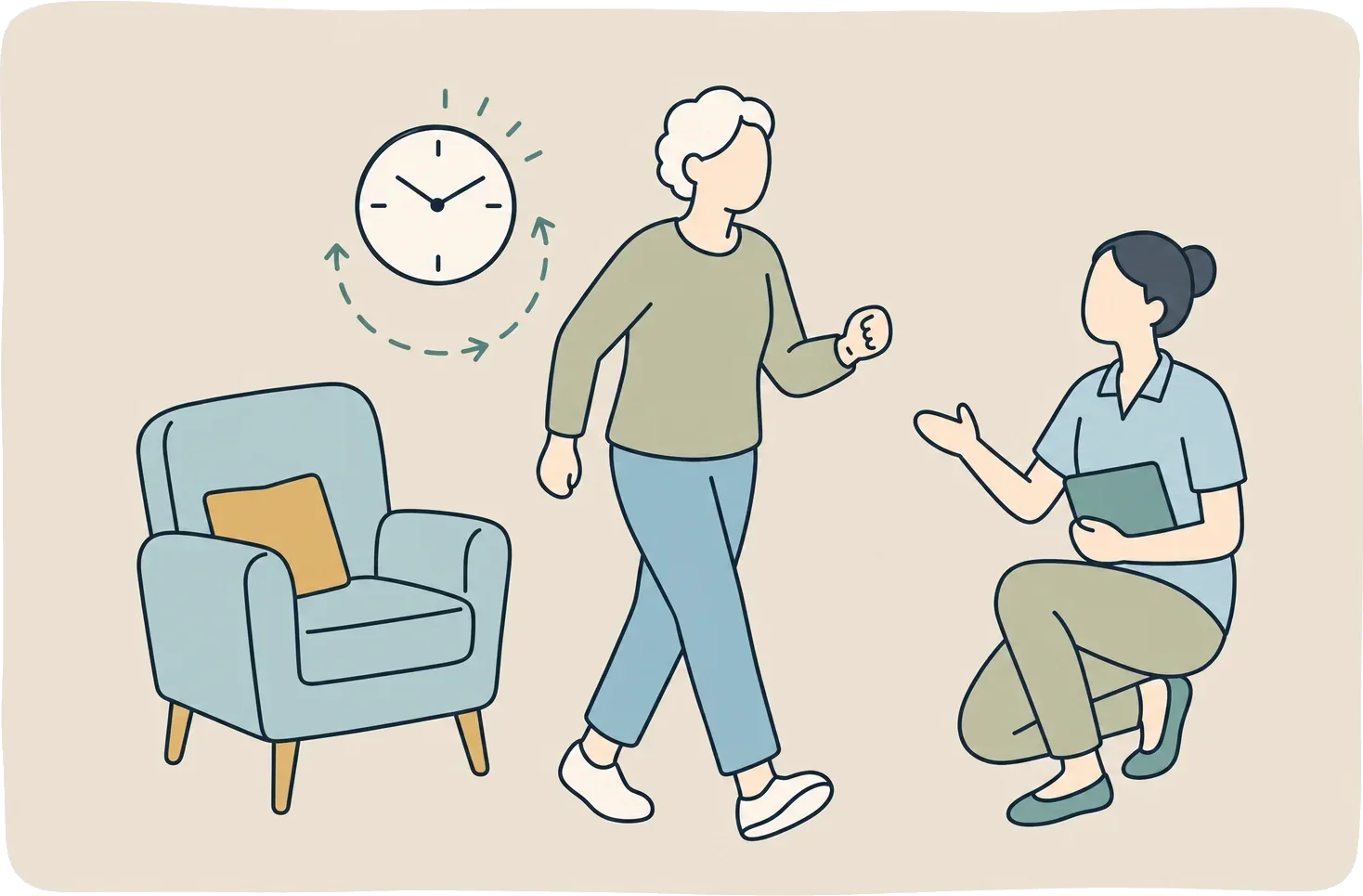
Sedentary behaviour — time spent sitting or lying while awake — is strongly associated with poor cardiometabolic health, frailty, and early mortality. These risks are especially pronounced for older adults with limited mobility, who may have few opportunities to be physically active and face structural barriers to reducing sitting time. Yet at the time this PhD began, almost no behaviour change trials had specifically targeted sedentary time in this population — research had focused on physical activity in healthier older adults, leaving people with mobility limitations underserved by the evidence base.
The PhD proceeded in three phases: a systematic review of existing interventions; development and measurement work to design a targeted behaviour change programme; and a randomised controlled trial — the INTEREST (INTErvention to REduce Sitting Time) study — which recruited older adults with osteoarthritis from NHS orthopaedic surgery services. I was Chief Investigator of the trial, which ran in complex real-world NHS conditions. The findings are reported in my 2020 thesis and a series of peer-reviewed papers.
The systematic review found no published trials that had specifically targeted sedentary behaviour in older adults with mobility limitations — a gap this PhD was designed to fill.
The research journey
From evidence gap to randomised trial
Outputs
Publications from this work
Funding
About PANINI
This PhD was supported by PANINI — Physical Activity and Nutrition Influences in Ageing — a Marie Skłodowska-Curie Innovative Training Network funded under the European Commission's Horizon 2020 programme. The network funding was secured by my supervisors; I was one of the early-career researchers it supported.
Conferences
Selected presentations
- Nov 2019Gerontological Society of America Annual Meeting"A randomised feasibility study to reduce sitting in older adults undergoing orthopaedic surgery"
- Jul 2019European College of Sports Science (ECSS), PragueDebated poster — INTEREST randomised controlled feasibility study
Continue exploring
Follow the behavioural and methodological foundations from the PhD into the current portfolio.
Behavioural science meets realist explanation
New frameworks for understanding complex intervention mechanisms.
→ Patient safetyA safety net for earlier diagnosis
Current pathway research with patients and NHS teams.
→ CollaborateDiscuss behaviour-change research
Get in touch about intervention development or evaluation.
↗