Data science work with University Hospitals Birmingham.
Project · Safety Net
A safety net for earlier diagnosis of lung cancer.
Making sure people with incidentally found pulmonary nodules receive reliable follow-up, so cancers can be identified while treatment is most effective.
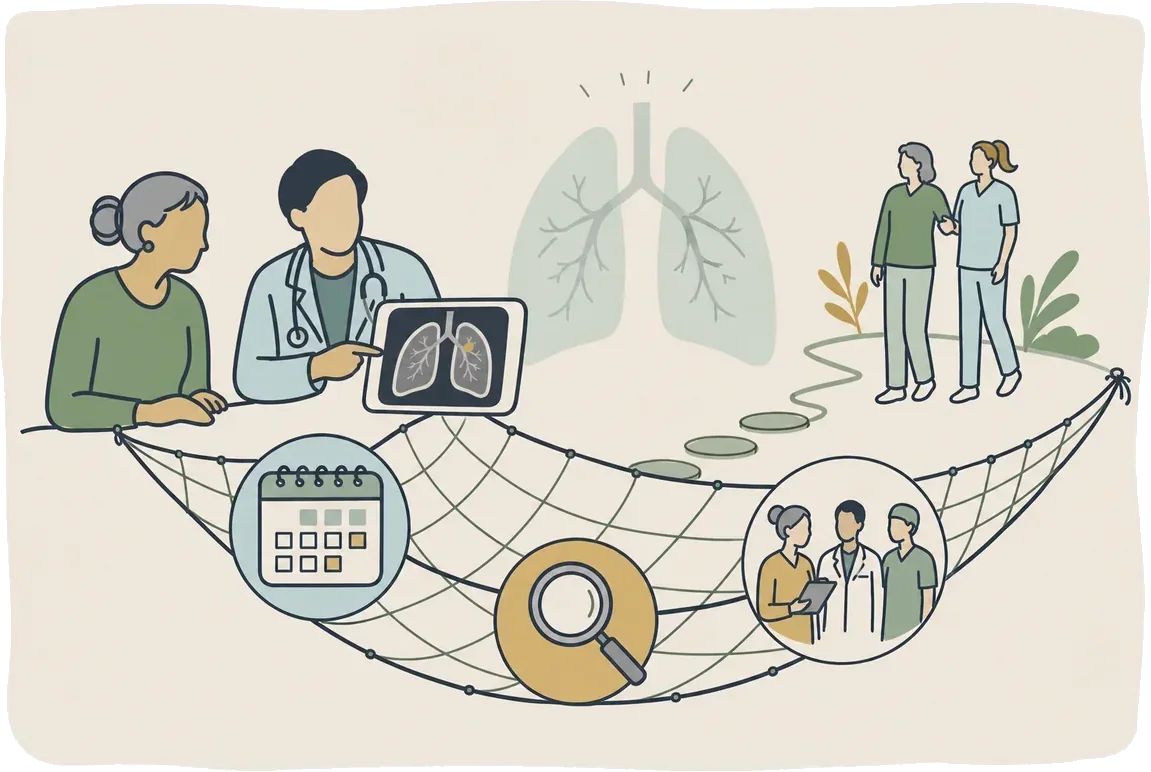
Pulmonary nodules — small lesions often spotted incidentally on scans done for other reasons — can be an early sign of lung cancer. Clinical guidelines set out how they should be monitored, but adherence is inconsistent, and patients who miss follow-up can go on to be diagnosed late, when treatment options are limited. This programme asks how the NHS can build a reliable safety net around these patients.
The work spans a systematic review in CHEST of interventions to improve guideline adherence for nodule management, qualitative research on the nodule care pathway, and pump-prime funded data science work with University Hospitals Birmingham using routine data to understand where follow-up breaks down. It is also a vehicle for capacity building: an NIHR-funded undergraduate internship on the programme led to a medical student gaining co-authorship on multiple papers and pursuing a clinical academic career.
Evidence at a glance
With an invited journal podcast for wider clinical reach.
Evidence synthesis, qualitative pathway research and routine data.
Featured podcast
The CHEST journal podcast
The American College of Chest Physicians invited Justin onto the CHEST journal podcast to discuss his first-author systematic review of interventions to improve adherence to clinical guidelines for the management and follow-up of pulmonary nodules — the evidence base for why follow-up breaks down, and what actually helps clinical teams keep patients on the pathway.
Watch on YouTube ↗Outputs
Publications so far
Interventions to improve adherence to clinical guidelines for the management and follow-up of pulmonary nodules: a systematic reviewFirst author
2025 · Aunger JA, Yip KP, Dosanjh K, Scandrett K, Ungureanu B, Newnham M, Turner AM · CHEST — with invited journal podcast
Funding
Grants in this programme
- 2024Understanding follow-up of pulmonary nodules at University Hospitals Birmingham to improve lung cancer survivability — £19.5k, Co-PIUniversity of Birmingham — Institute for Interdisciplinary Data Science and AI pump-prime funding
Impact
Reach beyond academia
- 2025Invited podcast for CHEST journal about the systematic review
- Nov 2024Poster presentation at the British Thoracic Society conference
Continue exploring
See how patient safety, behaviour and implementation connect across the wider research portfolio.
Patient safety
Safer cultures for healthcare staff and patients
Understanding the behaviours that threaten care.
→ Care pathwaysEquitable palliative care in the community
Realist research on integrated neighbourhood care.
→ CollaborateDiscuss a patient-safety partnership
Get in touch about diagnostics, pathways or implementation.
↗